
Fox News: ‘Forever chemicals’ found in US drinking water, map shows ‘hot spots’ of highest levels
The risk of having potentially harmful chemicals in your drinking water may depend on your zip code.
A study published in the journal Nature Geoscience on April 8, 2024 found that higher amounts of PFAS (perfluoroalkyl substances) were found in drinking water in certain parts of the U.S.
PFAS — also known as “forever chemicals” due to how slowly they break down — are a group of chemicals used during industrial processes and the manufacturing of consumer products.
Two of the main chemicals are perfluorooctanoic acid (PFOA) and perfluorooctane sulfonate (PFOS).
There are many ways people can be exposed to these chemicals — including in drinking water. See the full article on Foxnews.com
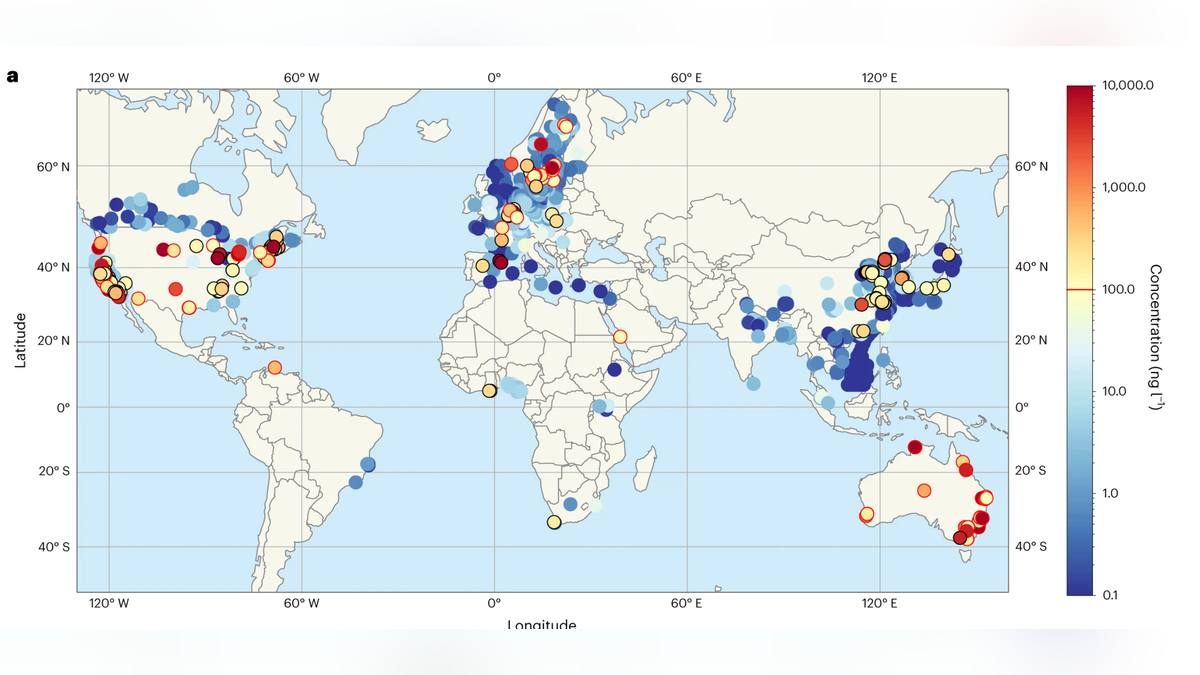
A study published in the journal Nature Geoscience on April 8 found that higher amounts of PFAS (perfluoroalkyl substances) were found in drinking water in certain parts of the U.S. (Nature Geoscience)
To determine the prevalence of PFAS in the environment, researchers from the University of New South Wales (UNSW) in Sydney analyzed a global dataset of 273 studies dating back to 2004.
The studies included data for over 12,000 samples of surface water (water that collects on the ground) and more than 33,900 samples of groundwater (water found underground, below the surface).
“We looked everywhere for PFAS concentrations in water data, including scientific journals and governmental reports and websites,” Denis O’Carroll, a UNSW engineering professor and senior author of the study, told Fox News Digital.
“We compared PFAS concentrations in these water samples to international regulations. We also compared the types of PFAS analyzed to what we found in consumer products.”
The studies included data for over 12,000 samples of surface water (water that collects on the ground) and more than 33,900 samples of groundwater (water found underground, below the surface). (iStock)
Nearly 70% of the samples had levels of PFAS that exceeded Canada’s minimum safety standards (30 nanograms per liter), while 6% had more chemicals than the European Union’s standard (100 ng per liter), according to the study findings.
In the U.S., PFAS “hot spots” were concentrated in the Midwest, New England and the West Coast, according to a map illustrating the findings — although the chemicals were also detected in other areas across the country.
Globally, Australia, Europe and China showed high levels.
“To date, nobody has looked at the global extent of PFAS in our waters and compared it to international drinking water standards,” noted O’Carroll.
“Our study found that a substantial fraction of sampled waters exceeded PFAS drinking water guidance values, with the extent of exceedance depending on the jurisdiction and PFAS source.”
Dr. Lisa Carter-Bawa, one of the researchers at the Center for Discovery and Innovation (CDI) in Hackensack, New Jersey, noted that while PFAS contamination has been detected throughout different states, higher concentrations have been found in communities near industrial facilities, landfills and airports, where PFAS-containing materials were used or disposed.
Health risks of PFAS
Dr. Mark Fischer, regional medical director of International SOS, a health and security risk mitigation company headquartered in London, pointed out that most Americans also have these chemicals in their blood.
“Although the use of these chemicals has declined in recent years, they are difficult to break down, so they are still found in some food, water and consumer products, as well as within the soil and the environment,” Fischer, who was not involved in the UNSW study, told Fox News Digital.
Health risks associated with PFAS include cancers, elevated liver enzymes, lower birth weight, heart issues and higher cholesterol. (iStock)
Most people in the U.S. have been exposed to these chemicals, most likely through contaminated food or their drinking water, according to the Centers for Disease Control and Prevention.
Health risks associated with PFAS include cancers, elevated liver enzymes, lower birth weight and higher cholesterol, Fischer said.
“PFAS contamination has been identified in drinking water in all 50 states.”
See the full article on Foxnews.com
Advanced Filtration Technology for a Healthier Home
The Waterboy Whole House Water Filtration System uses state-of-the-art filtration technology designed to remove or reduce a wide range of harmful impurities before they ever reach your tap. Its multi-stage filtration targets:
- Lead: A toxic metal with no safe exposure level.
- Chlorine: Common in municipal water and known to affect taste and irritate skin.
- Volatile Organic Compounds (VOCs): Industrial chemicals that may seep into groundwater.
- Pesticides and Heavy Metals: Frequently found in areas with agricultural or urban runoff.
With a 0.5-micron nominal filtration level, the Waterboy system effectively targets particulate and soluble lead—making it one of the most reliable options for homes concerned about aging pipes and corrosion.
Contact Superior Water for more information on a whole house water filtration system.